
What a Portable Hardness Tester Can and Cannot Measure
A portable hardness tester is often treated as a tool that hits anything. In practice it has four hard requirements, and missing any of them makes the number meaningless.
1. What it is for: three typical jobs
Machines and assemblies already in place. Equipment that cannot be dismantled or moved is where a portable unit is the only option.
Large castings, forgings and moulds. Too big for a bench tester stage, but flat enough and thick enough – exactly the case Leeb was designed for.
Period checks on equipment in service. Pressure vessels, pipework and rolls get their hardness re-verified on site in minutes.
2. What it cannot do: four hard limits
Too thin. If the section is not thick enough, the impact body passes through or reflects internally and the reading distorts. The working rule is at least ten times the diameter of the impact body.
Too soft, or a surface that has not been prepared. Mill scale, oil and coating all change the contact condition. Grind to bright metal first.
Too much curvature. Small shafts and thin-wall tube make it hard to hold the impact direction perpendicular, and the error is obvious.
Arbitration. A portable tester measures indirectly. Before a report goes out, cross-check against a bench instrument or a reference block.
3. The method shapes its behaviour
Leeb compares rebound velocity to impact velocity – a dynamic method. What it reports is the response of a local volume, which makes it very sensitive to structural non-uniformity. Wide scatter across one workpiece usually says something about the material, not about the tester.
4. Three habits in use
Keep test points away from edges and holes, where stress concentrates. Take several points per area and average. Re-check against the reference block whenever the material or the batch changes.
Conversion between Leeb and Rockwell or Brinell is approximate. State the scale used and the conversion basis in the report.
Summary
A portable hardness tester solves access, not accuracy. Used where the bench cannot reach, with a reference block holding the floor on the data, it is very good value.
Related products
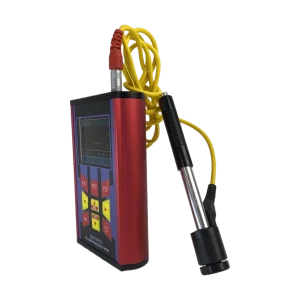
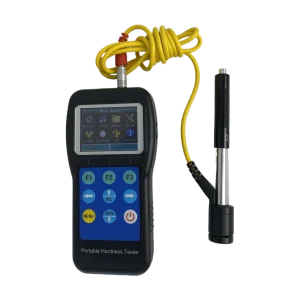
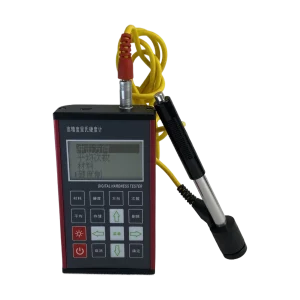
Tell us the workpiece, thickness range and accuracy you need — we will reply within 8 hours.