
What a Colour Screen Adds to a Hardness Tester
A dial asks you to crouch and squint. A monochrome digital unit puts everything on one grey screen. Colour earns its place by fixing reading, operation and traceability at once.
1. Three problems with the older displays
A dial requires leaning in to read a needle; poor light or an awkward angle produces errors, and batch work slows down badly.
Monochrome digital removed the reading error but stacked hardness value, scale, unit and alarm limits onto one small screen, so you page through to see everything and operation gets more complex, not less.
2. Information laid out instead of piled up
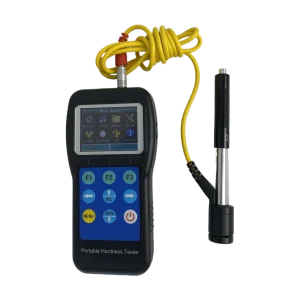
A colour screen divides the display: hardness value, test scale, converted value, live curve and test count each get their own zone, and different scales get different colours. Everything is visible at once, which cuts paging and misreading – most obvious in high-volume work.
3. Touch and a live curve
A graphical interface with touch input makes scale changes, parameter setup and storage a few taps. More useful is the live hardness curve: how widely several points on one workpiece scatter, and whether the material is uniform, reads faster as a curve than as numbers.
4. Storage and traceability
Internal storage files results by time and batch, history is browsable on screen, and export to Excel or PDF is one command. For a shop that has to trace quality, this removes the after-the-fact work of matching records to batches.
5. Matching the site
A workshop in strong light needs brightness and a wide viewing angle; a laboratory wants curves from different materials side by side; a classroom wants students to see the measurement happen. All three come down to the same thing: the information has to be readable on the spot.
Summary
Colour does not change how hardness is measured, it changes the distance between the operator and the data. Do not buy the biggest, brightest screen; confirm you can read it in your own lighting, export it, and trace it. That is enough.
Related products
Tell us the workpiece, thickness range and accuracy you need — we will reply within 8 hours.