
Cleaning and Protecting a Thickness Probe: A Checklist
The part that fails most often on a thickness gauge is not the circuit, it is the probe. Once the face is scored or the connector oxidises, the reading drifts - and most people blame the instrument.
1. Three steps after every use
Wipe the couplant. Clean the probe face and the contact area with a soft cloth, and do not let couplant dry on. Dried couplant cakes, and next time it sits between probe and surface like a shim.
Clear the gap. Metal swarf collects between the wear ring and the crystal. Work it out with a cotton bud, never with a needle or a blade.
Put it away. The probe goes back in its case, not loose in a tool bag with spanners and files.
2. A deeper service once a month
Check the connector for oxidation. If a BNC or three-pin plug looks dull or green, clean it with a little contact cleaner and work it in and out a few times.
Check the cable. The point of repeated flexing is where the conductor breaks. Run it through your fingers along its length; a hard spot or a flat means replace it.
Change the desiccant. Silica gel that has gone from blue to pink is saturated – dry it or replace it.
3. Extra protection in corrosive settings
At the coast, in chemical plant or in salt spray, fit a dust and water cover to the body and use a probe cable with a protective sheath.
Do not hose the body down at the end of a shift. Wipe with a damp cloth and dry it. Corrosive dust inside a connector is harder to deal with than water.
Before long storage, put a thin film of protective oil on parts that rust – but never on the measuring face, which would ruin acoustic coupling.
4. When to replace the probe
Three signs: the face is visibly scored and still unstable after dressing; the reading on one reference block is consistently low; the echo is weak and needs repeated gain adjustment to appear.
A probe is a consumable, not a spare part. Managing it as a consumable is cheaper than repairing it as a part.
Related products
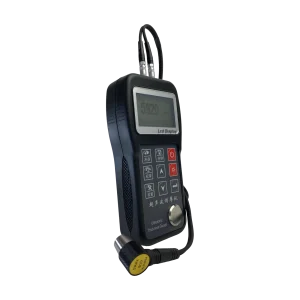
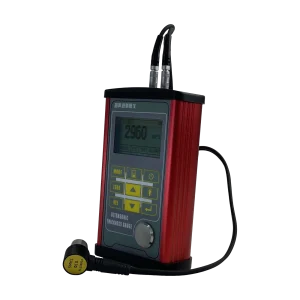

Tell us the workpiece, thickness range and accuracy you need — we will reply within 8 hours.