
Choosing a Coating Thickness Gauge: Principle First, Form Second
The common mistake is starting with price and appearance. The right order is: substrate and coating decide the principle, measuring position decides the form.
Step 1: choose the principle
Magnetic induction measures non-magnetic coatings on ferromagnetic substrates – paint, zinc, plastics on steel. Typical range 0 to 5 mm, stable and inexpensive, the workhorse for steel structures and car bodies.
Eddy current measures non-conductive coatings on non-ferromagnetic conductive metals: anodising on aluminium, paint on copper, coatings on stainless.
Dual-principle gauges combine both, with the probe detecting the substrate automatically. Useful where incoming material varies from batch to batch.
Ultrasonic covers non-metal substrates and multilayer stacks, up to 0.7 to 250 mm. Electrolytic methods handle thin coatings on wire; X-ray fluorescence measures extremely thin and alloy coatings, at a price and with a radiation source.
Step 2: choose the form
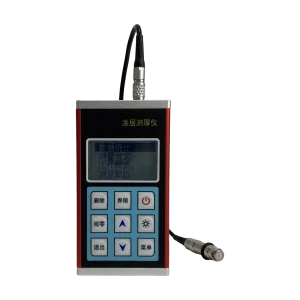
Integrated: probe and body in one, fastest to use, suited to flat surfaces and high volume.
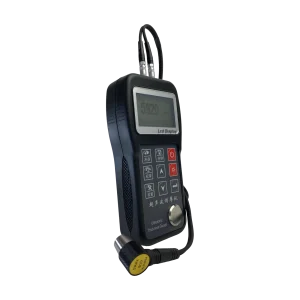
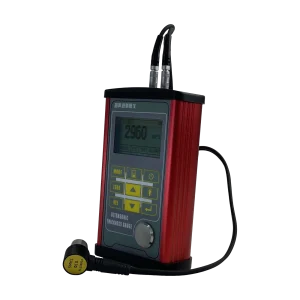
Separate: the probe is on a cable, so it reaches cavities, bore walls and narrow slots.
Benchtop: highest accuracy, for laboratory work and arbitration.
Step 3: three features people forget
Automatic substrate recognition: no manual mode switching when the workpiece changes, fewer human errors.
High/low limit alarm: audible and visual warning on out-of-tolerance readings, so nobody has to stare at the screen during batch inspection.
Statistics and storage: average, maximum, minimum and standard deviation, with export – acceptance reports come out directly.
Step 4: do not buy on the range figure alone
Nominal range is measured under ideal conditions. Real workpieces have curvature, roughness and temperature, and the usable range shrinks accordingly. If you can, test on your own parts before buying – it beats reading a datasheet.
Related products
Tell us the workpiece, thickness range and accuracy you need — we will reply within 8 hours.