
Roll Life Monitoring: What Ultrasonic Testing Sees Before Failure
A mill roll goes through many campaigns and regrinds between first use and scrap. Eddy current on the grinder only reads the outer 3 mm - core weakening is invisible to it. That gap is where ultrasonic testing sits.
Why rolls fail without warning
Work rolls take severe shear and contact stress at the surface; backup rolls take bending. Failure usually starts inside: core weakening, working-layer cracks propagating toward the core, heat cracks that survive grinding.
None of this is visible from outside. When a roll finally spalls, the loss is not only the roll – the mill itself can be damaged.
What ultrasound sees early
Core weakening in its first stage: before the large saddle-shaped spalling appears on the body, ultrasonic inspection picks up abnormal reflections from the internal structure.
Working-layer cracks: shear-induced cracks extend toward the core. Ultrasound locates them and marks their position so they can be ground out before the next campaign.
Residual heat cracks: when grinding has removed every visible open crack, ultrasound still tells you whether a crack remains just below the surface.
Sticking damage: after a sticking incident, ultrasonic inspection assesses severity and maps how the defect is likely to propagate in subsequent use.
Why not the eddy-current probe on the grinder
Eddy current reaches roughly 3 mm and responds mainly to open surface cracks. It cannot see the deeper working layer or the core. Fitting in-line ultrasonic equipment to a grinder is expensive, slows grinding and is awkward to operate.
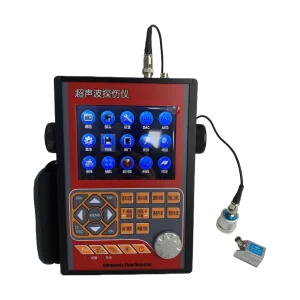
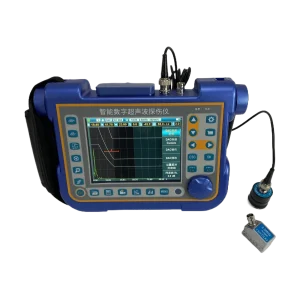
The practical route is a portable ultrasonic flaw detector, used once before the roll goes on the mill and once after each regrind, with results archived by roll number.
Turning data into decisions
Put each inspection result alongside the metal removed in grinding, the product being rolled and the campaign length. Over a few cycles a degradation curve emerges for that specific roll. It tells you when to regrind, how deep to grind, how to avoid exposing the core, and when a roll neck genuinely has to be retired.
Summary
Roll management is not about replacing rolls when they break. It is about knowing which part of the life curve a roll is on – and that is exactly what ultrasonic testing provides.
Related products
Tell us the workpiece, thickness range and accuracy you need — we will reply within 8 hours.